Ielts speaking chủ đề Litter/garbage

PART 1 

GARBAGE

Why do some people throw garbage on the street instead of using trash bins?

Well, those kind of people simply do not care about the environment. Those are the kind of people who lack self-discipline that throwing their trash anywhere has become their habit. It’s not that they lack of education but it’s because they don’t have any respect to the environment. 


LEXICAL RESOURCE


Lack [noun] – absence; shortage; inefficiency

Self-discipline [noun] – the ability to pursue what one thinks is right

Habit [noun] – practice; custom


TIP

i.) Here the speaker gave a realistic answer and explained his argument thoroughly. His reason focused on the character of the person and that made his answer very realistic.

What do you do if you see garbage on the street?


(Answer 1)


To be honest with you, I don’t do anything because in the first place, it’s not my trash. Well in our city, the local government has regular cleaners to maintain the cleanliness of our beloved city. Actually, it’s near to impossible to see some garbage on the street of our city since people abide the city regulations, if not, they will be penalized by paying a huge fine.


(Answer 2)


Well as I’m an advocate of protecting the environment, I do pick up the garbage on the street and put them in the trash bins. I often do that because I want to be a role model to the youth. I want to set myself as a good example to them that we the citizens of this world has an obligation to respect and protect the environment.


LEXICAL RESOURCE

Beloved [adj.] – dearly loved 

Near to impossible [idiom] – almost impossible

Abide [verb] – obey; follow

Penalize [verb] – punish

Fine [noun] – an amount of money to be paid for not obeying the rule

Advocate [noun] – a person who publicly supports a particular cause or policy

Pick up [phrasal verb] – to make the place clean

Role model [noun] – a person who is looked to by other people as an example

Obligation [noun] – responsibility


TIPS


i.) FIRST ANSWER: The speaker gave a straightforward negative answer then in order for him to expound his answer, he transitioned to talking about how clean his city was and what the government did in his city. In this case, he’s able to stretch his answer and that made him provide a brief answer. 


ii.) SECOND ANSWER: Here the speaker gave a very personal note. He talked about his drive to help conserve the environment and how he could impact to other people especially the youth. His answer here is a very well-thought and organized. 


How do you feel when you see people throw garbage on the street?


I do feel upset and miffed. There was a time that I needed to call out someone for throwing his trash on the street. To his surprise, he just picked his trash up and walked away. I believe he was so embarrassed. 

LEXICAL RESOURCE

Upset [adj.] – to be disturbed; unhappy

Miffed [adj.] – annoyed

Call out – criticize someone about something they have said or done

Walk away [phrasal verb] – to leave a place, situation, or a person 

TIP

i.) Here the speaker used some good descriptive words to answer the question about feelings. And in order for him to make his answer a bit longer, he talked about one instance when he needed to call the attention of one person who disrespected the environment. Because of that, the length of his answer became exact – neither short nor long.

Do you help in maintaining the streets tidy?

(Answer 1)

Well I don’t do anything except that I throw my garbage properly. Fortunately, the streets in our city are totally clean. You can never ever see any litter. Thanks to our government’s tremendous effort, people become educated about the importance of cleanliness.


(Answer 2)

Yes I do and I volunteer in a cleanup drive which is spearheaded by our town’s government officials every weekend. In our country, government leaders and officials are encouraging us citizens to take part in the government’s cleanup campaign. And I’m so inspired and happy that this campaign gets a positive response.

LEXICAL RESOURCE


Litter [noun] – trash; rubbish

Thanks to [phrase] – as a result to; due to

Tremendous [adj.] – very great; huge

Volunteer [noun] – a person who offers his service to do something; [verb] – freely offer to do something

Cleanup [noun] – an act to clean a place

Spearhead [verb] – lead

TIPS

i.) FIRST ANSWER: The speaker started his answer by giving a negative answer and used the sentence construction ‘except that…’ So basically his answer was not totally negative as he did something to the community to be clean. Then he shifted to talking about how clean their city was and how government played an essential role to maintain the cleanliness of their city. 


ii.) SECOND ANSWER: The speaker gave a positive response to the question then talked about his eagerness in cleaning. To add details to his answer,  he talked about the government’s campaign about cleaning and how people responded to the campaign.

Do you think your city is clean or not?
(Answer 1)

Well like I’ve just said, our city is absolutely clean, we the people in this city are law-abiding citizens. We follow the city regulations about cleanliness and we give importance to conserving Mother Earth. I’m more than happy that our efforts have come to fruition.


(Answer 2)

It’s such a shame to say no and I blame this to the city government because they don’t make any huge effort to clean our city. Of course, cleanliness starts at home but the lack political power of our city officials can be the main reason as well why our city is really dirty. I’m sure that when there is a strong implementation of the regulations about cleanliness for sure people follow. 


LEXICAL RESOURCE


Conserve [verb] – protect from destruction

Come to fruition [idiom] – to successfully realize

It’s such a shame [expression] – to say that something is unfortunate

Blame [verb] – to hold accountable


TIPS

i.) FIRST ANSWER: The speaker just reiterated on what he said about his city. Then talked about how they followed the regulations in his city and ended his answer by talking about his feelings. 

ii.) SECOND ANSWER: The speaker expressed his disappointment about how dirty his city was and how his government failed to address the problem. He pointed out the root cause of the problem and explained thoroughly. He sounded very natural on his first line by using a very good expression.


Tổng hợp Process gần đây

The IELTS Focus-  Hướng dẫn dạng Process

The diagram presents how olive is produced with the use of different equipment.

Overall, olive oil production involves four main stages and needs different equipment to achieve its desired appearance and flavour. The process starts with the breakdown of the olives after collection in a mill and culminates with storing the product in bottles until it is ready for consumption.

The process of making olive oil starts when olives are ground in a mill to create a paste. After the paste has been spread onto mats, this is transferred into a press where water is added. Following this procedure, the mashed olive paste is placed into a separation container where the oil goes through a natural separation process from vegetablewaters.

After separation, the mixture goes into the olive oil return, where more water is added and wastewater is subsequently drained. Once this process has ended, the olive oil is ready to be bottled, where it is stored for a period of time known as the clarification stage. Finally, once this time has passed the oil is ready to be used.

The IELTS focus

the process of making paper from the trees

The picture illustrates the process of making paper from the trees that have been collected.

Overall, it can be observed that there are eight stages in this process, beginning with the collection of trees from the forest and ending with the paper being made in the paper making machine.

To begin with, timber is collected from the forest and taken to be debarked. After the wood has been stripped bare, it enters the chipping machine, where it is chopped up into tiny pieces. From the chipping machine, the wood enters into three separate stages. First, the wood chips are put through the mechanical pulping process, where they are ground and smashed into pulp. Then they have a chemical pulping, going next into the hydra-pulper. 

In the subsequent stage, the mixture goes through to be screened and cleaned, to filter any lumps or waste from the pulp. Lastly, the pulp is entered into the paper making machine, where it is pressed to make sheets of paper. The paper is then stored and stacked, ready for shipping and to be used.

the process of waste paper recycling.

 The chart below shows the process of waste paper recycling.

Biểu đồ miêu tả quy trình tái chế giấy

Biểu đồ miêu tả quy trình tái chế giấy

The flow chart shows how waste paper is recycled. It is clear that there are six distinct stages in this process, from the initial collection of waste paper to the eventual production of usable paper.

At the first stage in the paper recycling process, waste paper is collected either from paper banks, where members of the public leave their used paper, or directly from businesses. This paper is then sorted by hand and separated according to its grade, with any paper that is not suitable for recycling being removed. Next, the graded paper is transported to a paper mill.

Stages four and five of the process both involve cleaning. The paper is cleaned and pulped, and foreign objects such as staples are taken out. Following this, all remnants of ink and glue are removed from the paper at the de-inking stage. Finally, the pulp can be processed in a paper making machine, which makes the end product: usable paper.

waste glass bottles are recycled

SAMPLE ANSWER ONE (Simple)

The process shows how waste glass bottles are recycled. Write a report of at least 150 words describing the main details.

The process shows the stages in the recycling of glass bottles. The process includes three main stages, beginning with used bottles and ending with new bottles being sold in stores.

To begin with, empty bottles are brought to a collection point. From the collection point the bottles are taken by truck to a factory where the second stage begins.

First, the bottles are washed with high-pressure water. After that, the bottles are divided into green, brown, and clear types and each of these types is broken into small pieces of glass. Next, the glass pieces are put into a furnace where they are heated at between 600 and 800C. Following this, the liquid old glass is combined with some new glass that is also in liquid form. Both types of glass are poured into a mold in the shape of a bottle.

Finally, in the last stage the bottles are filled with whatever product is required and then they are transported to stores where they can be sold. (167 words)

T1 Process - RecyclingSAMPLE ANSWER TWO (Advanced)

The process shows how waste glass bottles are recycled. Write a report of at least 150 words describing the main details.

The diagram provides an outline of the steps involved in recycling old glass bottles. The process can be divided into three major stages, beginning with waste bottles and concluding with the sale of products in new glass bottles.

After glass bottles have been used, they are brought to a collection area where they are kept until a truck transports them to a recycling facility.

Once the bottles have arrived at the recycling plant, the first thing that happens to them is they are washed with water under high pressure to remove any dirt and other contaminants. After the bottles are clean, they are sorted into three groups based on the colour of the glass: brown, green, or clear. Next, the glass is broken into small pieces and the pieces are heated in a furnace at 600-800C, which causes the glass to melt. Subsequently, the liquid old glass is combined with new liquid glass and the mixture is poured into bottle-shaped molds.

Finally, the new bottles are filled with some kind of product which is delivered to stores and made available for sale. (182 words)

Feedback của học viên

🚀🗽🚀Feedback học viên của thầy Khánh và thầy Quang bên dưới comment

Zalo tư vấn 0847705973

🌈💕💁🏻‍♂️Lịch Khai giảng các lớp IELTS quận 2 và Quận 6 https://bitlylink.com/RCWlS

🌈 Yến Ngọc 15 tuổi IELTS 7.5 https://youtu.be/RPM0e8XBoY4

🌈Nhung 13 tuổi https://youtu.be/t_kdMphF_aE

🌈Triệu My lớp 12 IELTS 7.0 https://youtu.be/xAbAoXfqYz4

🌈Minh Nam lớp 12 IELTS reading 8.0 https://youtu.be/DS01nrLV7Ug

🌈Nhung 13 tuổi https://youtu.be/t_kdMphF_aE

🌈Huy tăng speaking 7.5 (tăng 2 điểm) và listening 8.5 tăng 2 điểm sau 2 tháng https://youtu.be/FMASOJ82GU4

🏖Hồng An cô gái năng động với hoạt động tình nguyện đạt 7.0 IELTS , Lis 7.5 Speaking 7.0

SAT Toán 790/800

🌈 Trường Sơn IELTS 6.5 https://youtu.be/t_kdMphF_aE

🌈 Tấn Khang cựu học THPT Mạc Đĩnh Chi ielts 7.0 reading 8.0 nhờ đọc Manga

🌈 Nam Tiến đã Tăng 2 điểm #Reading

Tăng 1 điểm #speaking và 0.5 cho 2 kỹ năng còn lại. https://youtu.be/Lbx8VG5SxiE

LUYỆN THI IELTS CÀNG SỚM TẠI #theieltsfocus, THÀNH CÔNG CÀNG CAO

Zalo tư vấn 0847705973

#ielts #ieltsquan6 #ieltsquan2 #louisquangvo #louisielts

The diagram below shows the life cycle of a salmon, from eggs to adult fish.

ielts-writing-task-1-process-life-cycle-of-a-salmon

Sample Answer

The diagram illustrates various stages in the development of a salmon.

Overall, there are eight stages in the life cycle of the salmon, starting with eggs and continuing until they become fully-grown adults.

At the first stage of the life cycle, female salmons choose the best spot in rivers and lay a massive number of eggs, which are then incubated before developing into tiny fish. At this point, the fish have a long tail and do not yet have the appearance of a normal fish. In the next stage, the fish grow quickly in size and move downstream to freshwater areas, which are suitable for rearing, before migrating to estuaries where they continue to be reared.

At the following stage of the life cycle, the young fish become much bigger and begin their journey to the ocean where they develop into mature adult salmons. The adult fish migrate upstream to spawning areas of rivers where they will mate and spawn, and the life cycle starts again.

the carbon cycle in nature

IELTS Writing Task 1: Question

A cycle diagram is a variation on the process diagram in which the process repeats itself. So it’s a good idea to make that point in your answer.

The diagram below illustrates the carbon cycle in nature.

Write a 150-word description of this diagram for a university lecturer.

Carbon Cycle

IELTS Writing Task 1: Model Answer

The diagram shows how carbon moves through various stages to form a complete cycle. This report will give a brief description of the main stages in this cycle.

First, we can see that energy from the sun is transformed into organic carbon through a process in plants known as photosynthesis. This organic carbon is then transferred underground when plants, and the animals that feed on them, die and decay. Some of this carbon is trapped underground in the form of fossils and fossil fuels.

Carbon is also released back into the atmosphere, however, through various means. One is when animals and plants respire, and another is when humans burn fossil fuels in cars and factories. All this carbon enters the atmosphere as CO2. It is then reabsorbed by plants, and the cycle begins again.

Overall, we can see that carbon moves in a natural cycle, although human factors may now be affecting the balance.

the process of waste paper recycling.

 The chart below shows the process of waste paper recycling.

Biểu đồ miêu tả quy trình tái chế giấy

Biểu đồ miêu tả quy trình tái chế giấy

The flow chart shows how waste paper is recycled. It is clear that there are six distinct stages in this process, from the initial collection of waste paper to the eventual production of usable paper.

At the first stage in the paper recycling process, waste paper is collected either from paper banks, where members of the public leave their used paper, or directly from businesses. This paper is then sorted by hand and separated according to its grade, with any paper that is not suitable for recycling being removed. Next, the graded paper is transported to a paper mill.

Stages four and five of the process both involve cleaning. The paper is cleaned and pulped, and foreign objects such as staples are taken out. Following this, all remnants of ink and glue are removed from the paper at the de-inking stage. Finally, the pulp can be processed in a paper making machine, which makes the end product: usable paper.

production of a lead pencil – ielts process

Man-made process – Production of lead pencils 

The diagram below shows the production of a lead pencil.

Summarise the information by selecting and reporting the main features, and make comparisons where relevant.

Write at least 150 words.

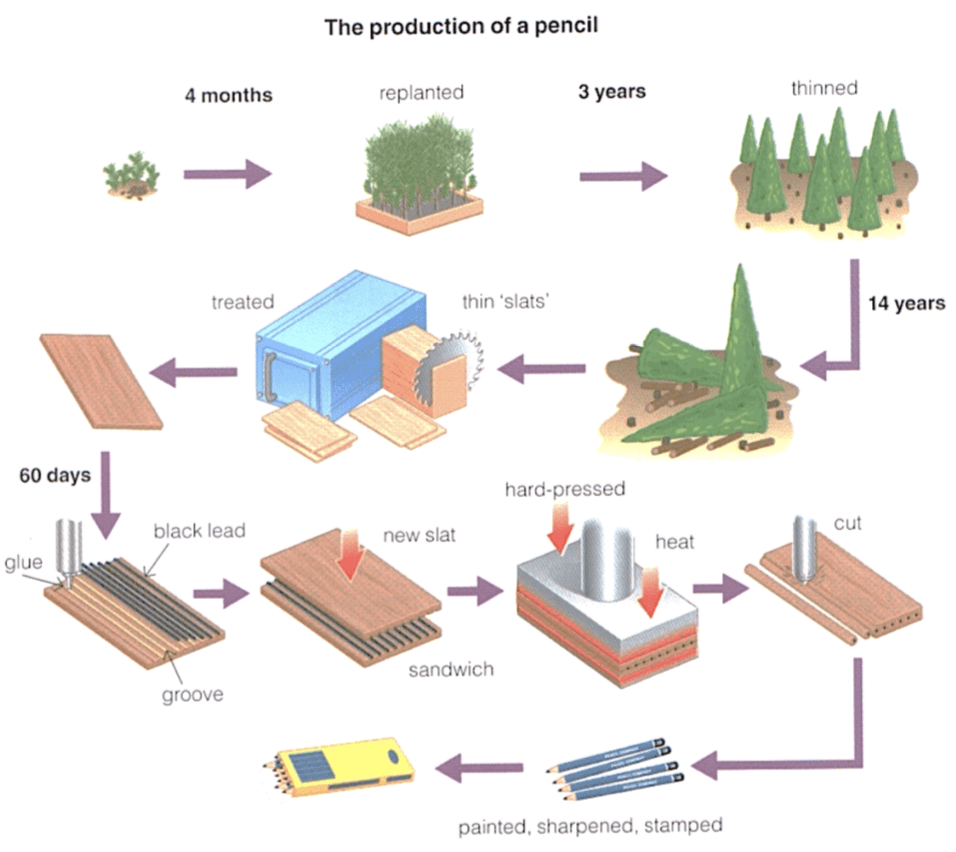
The diagram illustrates the steps and equipment involved in the process of making lead pencils.

Overall, the production has multiple stages starting with planting trees and ending with packaging complete products.

In the first place, seeds are sowed in nurseries before seedlings are replanted four months later. After three years, the plantation is thinned facilitating the growth of the trees and improving the quality of the wood. Once the trees are 14 years old, they are now ready to be used for the manufacturing of pencils and they are chopped down to make logs. The wood obtained is cut into thin pieces, treated to become dry and then left 60 days.

Coming to the next step, a groove is made into the slat and a special glue is injected. After that, a black lead is put into the slat followed by the replacement of an empty slat on top to form a sandwich, which is heated and hard pressed. By this action, the two slats are converted into one piece which is then cut to produce individual pencils. Lead pencils come to the final stages by being painted, sharpened and stamped, after which they are packaged before reaching consumers.

Word count: 199 words.

Two different processes for manufacturing black tea

You should spend about 20 minutes on this task.

The diagram below shows two different processes for manufacturing black tea.

Summarise the information by selecting and reporting the main features, and make comparisons where relevant.

Write at least 150 words

MANUFACTURING TEA

Ielts Writing Task 1

Model answer:

The diagram shows the two processes for manufacturing black tea. The traditional way is used for making loose tea and modern process is ideal for teabags.

When collecting tea, the tea picker picks only the two top leaves and the bud of ensure a high quality tea. Then, the tea leaves go through withering, where leaves are spread out and air is passed through withering, where leaves are spread out and air is passed through them to remove up to 60 per cent of their moisture.

After that, the leaves are ready for rolling or cutting. Factories use traditional methods of rolling and crushing or faster modern methods of cutting, tearing and curling to make teabags. In both processes, natural enzymes are produced from the leaves. The next step is oxidation, where the enzymes from the leaves mix with the air. This changes the colour of the leaves from green to copper and creates a nice flavour and aroma. Finally, the leaves are fired and dried. By this stage, little moisture remains in the tea-just three per cent.

(178 words)

the process of making five types of tea.

The diagram below shows the process of making five types of tea.

Summarize the information by reporting the main features and making comparisons where relevant. You should write at least 150 words.

process-tea

The diagram outlines the steps involved in the production of five varieties of tea. Although all five kinds of tea are derived from the same variety of tea leaf, the leaves undergo different methods to ultimately create the diversity of teas.

After the tea leaves have grown, they are plucked from the plants and then withered to reduce moisture content. Leaves to produce white tea are then simply dried in an oven before they are ready for use.

In fact, the oven drying stage is the same for all of the types, but there are differences in the steps in between. Leaves for green tea are steamed and subsequently rolled before drying, while oolong and large-leaf black tea is only rolled.

The two remaining tea varieties differ in that they are put through a fermentation process. Leaves that will become oolong tea are partially fermented following being rolled, while large-leaf black tea, in contrast, is fully fermented. Finally, leaves destined to be small-leaf black tea, instead of being rolled, are crushed before fermentation,  which creates the small-leaf appearance. (180 words)

Process of milk production

Process - Milk Production

FULL SAMPLE ANSWERS

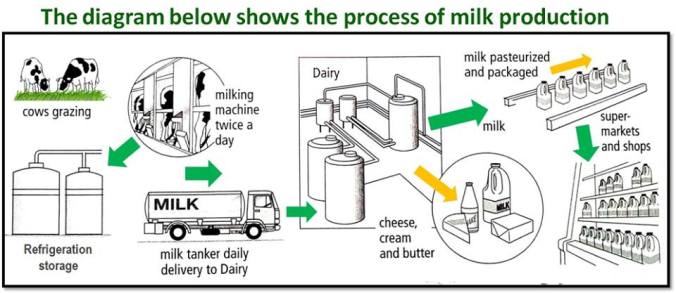
SIMPLE – The diagram indicates the key stages in production of milk

Producing milk begins with cows eating grass in a field and ends with milk and other related products being sold in stores.

In the first step, cows eat grass in a field. Twice a day, the cows are taken to a place where they are milked by a special milking machine. Once the cows have been milked, the milk is stored in large refrigeration tanks in order to keep it fresh. Every day, a milk tanker takes the milk from storage and delivers it to a dairy.

At the dairy, the milk is used in two ways. Some of the milk is pasteurized and packaged into bottles for sale. On the other hand, some of the milk is used to produce cream, cheese, and butter. Finally, the finished products are taken to stores where they can be purchased by customers. (150 words)

ADVANCED – The diagram outlines the principal stages in milk production as well as the manufacture of other dairy products.

Milk production begins with a herd of dairy cows grazing on grass and ends with dairy products being purchased by consumers.

As previously stated, the initial stage in the process is cows feeding on grass in a field. Twice a day, the cows are taken from the pasture to a milking facility where they are milked by an automated milking machine. The resulting milk is kept fresh in large refrigerated storage tanks. On a daily basis, the milk is collected by a milk tanker and transported to a dairy factory where further processes are applied to it in order to create a range of products.

Some of the milk is pasteurized – heat-treated to kill any harmful bacteria – while the rest is converted into other dairy products: cheese, cream, and butter. Ultimately, the finished dairy products are transported to shops and supermarkets where they may be purchased by the general public. (170 words)

the process of making instant coffee

SAMPLE ANSWER

The diagram shows the process of making instant coffee. Write a report of at least 150 words showing the main features and making comparisons where relevant.

process-coffee-production

FULL ANSWER

The diagram illustrates the steps involved in the manufacturing of instant coffee, beginning with picking the beans and ending with sale in stores.

In order to produce instant coffee, the beans must undergo a variety of processes including drying, grinding, heating, and cooling.

To begin with, coffee beans are harvested by hand and then left out in the sun to dry. Once the beans are dry, they are roasted in a special oven and then cooled rapidly. Next, the beans are ground into a powder which is then combined with hot water. Following this, the mixture is strained and then the filtered material is frozen. In the subsequent stage, the frozen mixture is ground once more and then the granules are dried in a vacuum, which is used in order to completely remove all moisture. Finally, the dried instant coffee powder is packaged into containers and can now be transported to stores for sale. (154 words)